
The Time Sector System: The Antidote to “AI-Generated Work Bloat”.

According to The World Economic Forum’s article AI Paradoxes: Why AI’s Future Isn’t Straightforward, rather than reducing our work input, AI is increasing it.
And then there are examples of one employee using AI to turn a few bullet points into a 10-page proposal, and the recipient using AI to summarise that proposal back into bullet points. Adding volume without adding value, creating a cycle of low-value content that everyone still has to oversee.
This "task-bloat" epidemic has created a paradox where the very tools designed to save us time (AI agents, automated workflows, and instant messaging) actually increase our cognitive load and create more work.
In 2025, this evolved from a minor annoyance into a significant organisational crisis.
I recently ran a small experiment and asked Google’s Gemini to give me a list of tasks, spread over four weeks, that would result in creating a blog. I was not specific about the blog’s content; I just wanted to know what I needed to do to start a blog.
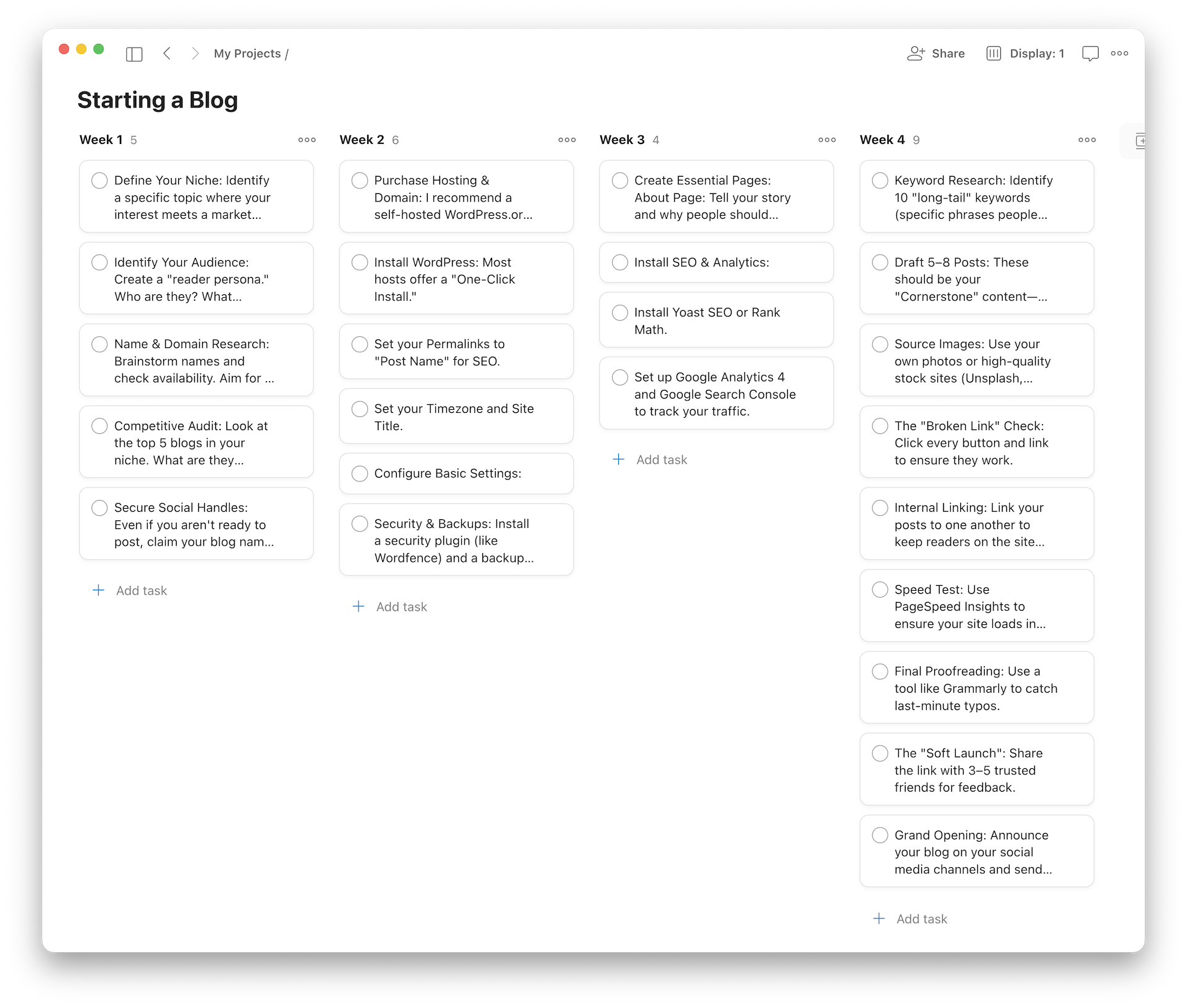
Aside from the length of this list putting off around 90% of anyone who may be thinking about starting a blog, it is comprehensive, and I would say that it has everything covered.
It’s like an overeager new employee doing too much to try and impress their new employer. (They’ll learn!)
However, one flaw is that no actual writing is started until week 4.
I’ve been writing blog posts every week for over ten years, and as a writer, I know the number one important thing about writing is you write.
Searching for keywords, deciding where to host your blog, installing SEO software and setting up Google Analytics may, in time, become important, but they are pointless if you have nothing to post on your blog.
Most people who want to write a blog already know what they want to write about. It’s an interest, a passion or something they know a lot about. It’s these areas that produce the best, most interesting writing.
Algorithmically optimised posts on topics the writer barely has an interest in don’t do well, and people are not stupid; They can tell.
Searching for keywords about subjects that may not have been written about before misses the area where an individual may have incredible stories to tell or life-changing ideas to share.
If a person were to take that list and put it into their task management system and were determined to follow it, once it came into contact with everything else in a person’s personal and professional life, they would be swamped.
Here’s my alternative, human-generated list:
Write first draft of blog post
Edit blog post
Post blog post to Substack/Medium/company website, etc
I accept that if you do not have a platform to post your first post, you may need to do a little research, but by writing your first post, you will have a much better idea of who it will interest, and you can move forward on that basis.
You are also doing the most important thing: writing.
The knowledge worker challenge
The challenge for knowledge workers today is that AI-generated lists create far too many tasks for any individual to realistically handle. This means the list needs to be audited to ensure it is not overwhelming.
Last year, I saw an exponential increase in the number of tasks in my coaching clients’ task managers. These tasks were largely created by AI-generated meeting summaries. These summaries often listed what the AI tool “thought” were the next actions, and it’s those tasks that are copied/pasted into task managers.
The issue is an age-old one. While you have infinite possibilities for what you could work on, you don’t have an infinite number of hours in which to work on them. Time is your limiting factor.
This means an additional step is required before you copy/paste these AI-generated tasks: A Task audit. Removing the unnecessary tasks—and there are a lot of them!
This is where the Time Sector System comes in.
Aside from organising your to-dos by when you will do them, the Time Sector System ensures that you are not attempting to do more than is possible in any given week. An automatic task audit is conducted at every Weekly and daily Planning Session.
Once you have finished planning your week, you review the tasks you have allocated to yourself. If that number exceeds your limit, you go back in and reduce the list. (It may take you a few weeks to learn where your limit is)
After all, it doesn’t matter how many tasks you have to do if you don’t have the time to do them. They’re not going to get done.
Another part of the system is to allocate time for doing particular tasks. For example, we all have communications to deal with, so you add a protected block of time to your calendar (or ask AI to do it for you) each day to handle your emails, messages, and phone calls.
Ignoring your communications is one guaranteed way to build up backlogs, which will require a disproportionate amount of time to clear—time that you won’t necessarily have.
This planning system ensures that you audit any list AI may have generated by giving you time to review your tasks and decide whether they actually need to be done.
Instead of letting AI-driven volume overwhelm your to-do list, the Time Sector System can counter the AI work bloat in other ways, too:
The "When" Over the "What": AI is excellent at generating "what" (tasks, projects, ideas). The Time Sector System ignores complex project folders and instead asks one question: "When am I going to do this?” By moving tasks into time sectors (This Week, Next Week, This Month), you prevent AI-generated "noise" from cluttering your immediate field of vision.
Capacity-Based Filtering: AI creates a "productivity paradox" where it saves time but leads to more work being assigned. The Time Sector System uses the This Week sector as a brake. If a task doesn't fit into the time you actually have available this week, it is moved to Next Week or This Month, effectively capping the bloat.
Human Agency vs. Algorithmic Chaos: Many AI productivity tools try to "auto-schedule" your day. The problem is that a computer doesn’t know if you are feeling unwell or having a low-energy day. The Time Sector System returns agency to you, requiring a Weekly Review where you, not an algorithm, decide which AI-generated tasks are actually worth your time.
The 5% Rule: The Time Sector System is built on the philosophy that you should spend only 5% of your time organising and 95% of your time doing. AI bloat often lures people into "productivity procrastination" by fiddling with AI prompts and organising AI outputs. The Time Sector System’s simple structure (only 6 folders) makes over-organising impossible.
Eliminating "Project Bloat": Traditional systems encourage tracking every sub-task of a project. AI can generate hundreds of these. The Time Sector System ignores sub-tasks and focuses only on the Next Action. By only seeing the "Next Step" for "This Week," you avoid the paralysis of looking at a 100-step AI-generated project plan.
AI is here to stay, and it’s going to allow us to do many amazing things, yet, as with all new technology, there’s a period when we go a little too far with it before we back off and let it help in ways that make life a little bit easier.
You can get ahead of this by using the Time Sector System to curate your workload so you are not overwhelmed by unnecessary AI-generated work-bloat and stay focused on what matters most.
You can learn more about the Time Sector System here.
If you'd like more time management tips (like this one) in your inbox, please do join my newsletter
Get a copy of my latest book, Your Time Your Way: Time well managed, life well lived.